
Copilot AI
Unlocking Product-Market Fit and Investor Confidence
Case Study

Overview
Client: Copilot AI
Industry: SaaS / AI Sales & Marketing Technology
Stage: Scale-Up
Market: Global
Engagement: Advisory to Executive Team
Copilot AI is a leading Canadian AI SaaS venture operating in the sales and marketing technology space. Despite strong early interest, the company’s first product struggled to gain traction, facing stalled growth, low conversions, and morale challenges.
Challenge
Following its initial product launch, Copilot AI experienced early customer churn and weak product-market fit.
Despite executing the right frameworks — Predictable Revenue and Lean Startup methodologies — the team was not getting the adoption or feedback loops expected.
The root problem was not in the process, but in the premise. The product was positioned to help users “manage risk,” but the company’s ideal customers were far more motivated by finding and converting new leads. This misalignment created friction across sales, product, and brand, and slowed growth.
Approach
As an Advisor to the senior leadership team, I was brought in to diagnose the issue and reposition the company’s go-to-market (GTM) motion.
Key Actions:
- Conducted qualitative and quantitative interviews with both current and churned customers.
- Discovered that while the discovery process had been executed properly, it asked the wrong questions, missing the customer’s most urgent pain point.
- Reframed the product narrative from “risk management” to “lead generation,” aligning engineering, sales, and brand around this central theme.
- Coached teams to run rapid experiments on new messaging and user engagement tactics focused on lead sourcing.
- Retooled the Sales, Brand, and Demand Generation functions to match the new positioning.
- Leveraged my venture capital background to secure unfiltered prospect feedback and validate the pivot in real-time.
This approach prioritized speed, clarity, and market empathy over rigid adherence to frameworks — enabling faster decision cycles and organizational alignment.
Results
Quantitative Outcomes:
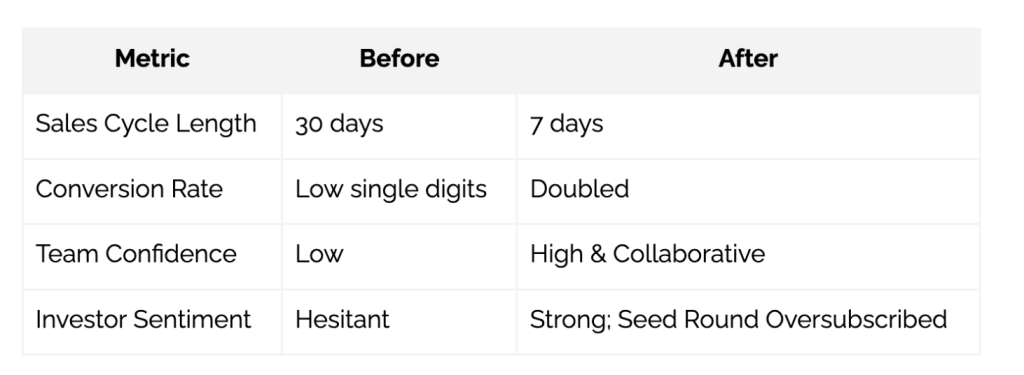
- Significant revenue growth post-pivot
- Shorter sales cycles, increasing conversion velocity
- Reduced churn and improved customer retention
- Higher margins from refined targeting and qualification
- Successful, oversubscribed seed round raised following renewed investor confidence
Qualitative Outcomes:
- Rapid boost in team morale and culture of experimentation
- Clearer internal alignment between engineering, sales, and marketing
- Strengthened brand reputation in the sales automation sector
- Renewed sense of purpose and urgency across the leadership team
Strategic Insights
Key Decision:
Acknowledging that “doing everything right” can still lead to the wrong result — and having the humility to pivot fast.
Hidden Blind Spot:
The belief that process alone defines success. True transformation required looking beyond the data and engaging with human insight, intuition, and direct market feedback.
Lessons for Others:
- Data tells you what’s happening; anecdotes reveal why.
- Diverse perspectives — especially from outside the immediate industry — can uncover new growth levers.
- Product-market fit often hinges not on technology, but on emotional alignment with the customer’s true motivations.
Conclusion
By realigning Copilot AI’s GTM narrative to the authentic pain points of its market and instilling a culture of experimentation, the company transitioned from stalled traction to a thriving, growth-oriented scale-up.
The engagement proved that clarity of problem beats complexity of process — and that the right insight, at the right time, can change a company’s trajectory.