
Spark
Rebuilding Trust, Structure, and Scale in PropTech
Case Study

Overview
Client: Spark
Industry: PropTech / Real Estate Technology
Stage: Early Startup
Geography: Pacific Northwest
Profitability: Net-Zero Churn & Constant Upselling to Existing Customers.
Engagement: Advisor and Interim Executive
Spark, a PropTech startup, entered the market with a promising concept but lacked the internal alignment and operational discipline to scale. Despite a passionate founding team, the company faced challenges in market positioning, revenue structure, and investor readiness — all compounded by the lingering effects of an early, damaging investor relationship.
Challenge
At the time of engagement, Spark was struggling with:
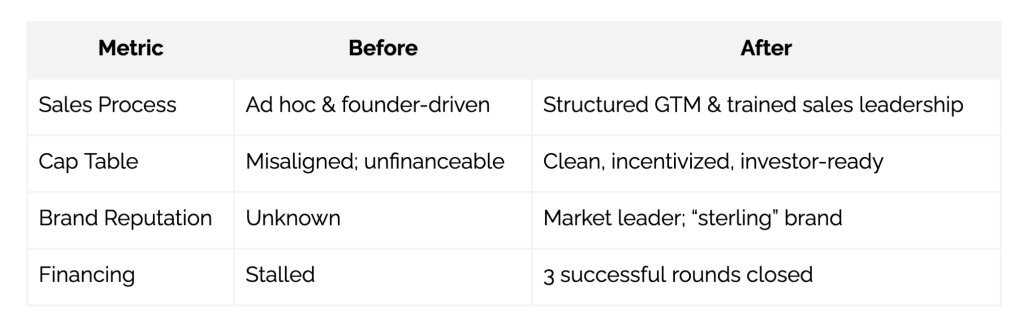
- Misaligned market approach: Applying traditional real estate sales methods to a SaaS product model.
- Absence of revenue systems: No structured go-to-market process or repeatable sales motion.
- Broken capitalization table: A structure that made the company unfinanceable and discouraged key contributors.
Early traction had come almost exclusively through personal networks and friendly referrals. The company had no growth engine, no scalability path, and limited investor appeal due to the lack of governance and equity alignment.
Approach
I joined as Advisor and, for a period, Interim Executive, with a dual mandate — rebuild trust within the founding team and restore structural integrity to make the business investable and scalable.
Key Actions:
- Re-established trust and stability: Spent significant time developing authentic relationships with founders who had been burned by an early investor. This was foundational to creating space for strategic change.
- Introduced education and process discipline: Shifted decision-making from reactive to data-informed, removing noise and emotional bias from major choices.
- Implemented private equity frameworks: Used a diagnostic approach honed in private equity to identify, prioritize, and resolve high-impact problems fast.
- Enabled financing readiness: Introduced the company to a trusted private equity partner to clean up the cap table, align incentives, and prepare for external capital raises.
Built internal capability: Trained the leadership team on structured problem-solving and operational cadence, enabling them to sustain discipline after my exit.
Results
Quantitative Outcomes:
- Accelerated revenue growth through shorter deal cycles and stronger sales training.
- Expanded geographic footprint across the U.S. and Canada.
- Completed three successful financings that fueled product development and commercial expansion.
- Enhanced operational scalability and accountability across business units.
Qualitative Outcomes:
- Spark’s brand reputation evolved into one of the most respected in North American PropTech.
- The company became known as a destination for top-tier talent.
- The internal culture cultivated a new generation of leaders — several of whom went on to launch successful ventures of their own.
- Investor confidence and internal cohesion increased dramatically, creating long-term stability.
Strategic Insights
Key Decision:
Slowing down to rebuild trust — even when urgency was high — proved essential. Forcing rapid change without psychological safety would have fractured the team and doomed execution.
Hidden Blind Spot:
The founders believed selling software into real estate followed the same playbook as selling real estate itself. This assumption created friction and misalignment across every sales and marketing effort.
Lessons for Others:
- Trust is the foundation of execution. Without it, even the best strategy will fail.
- Pacing matters. Going slow early can accelerate success later.
Rebuilding structure and confidence simultaneously is a leadership act — not a management task.
Conclusion
By restoring trust, discipline, and investor readiness, Spark evolved from a disorganized startup into a respected PropTech brand with sustainable growth momentum.
This engagement underscored a universal truth in venture building: the speed of trust determines the speed of scale.